

Home The record The technology The method Send me your process

The method

The method was written down before the software was built.

When an autonomous agent does the work, judgment has to move upfront — out of the review of each result and into the specification the agent works from. That is the whole idea, and it was formalised in print before a line of AI++ existed.

Three things follow from it, in order: a book that set out the method, software that executes and verifies it, and a store of decisions that takes the engineering out of it.

One · the method

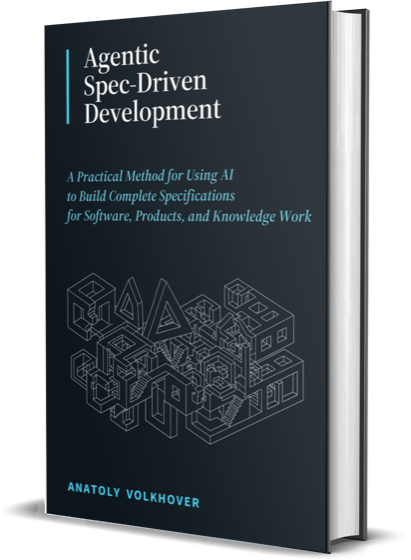
Agentic Spec-Driven Development — book cover

#1 best seller software engineering · amazon, summer 2026

Agentic Spec-Driven Development

A practical method for using AI to build complete specifications — for software, products, and knowledge work.

Apply your judgment as you go, reviewing each result turn after turn, and you are the bottleneck: the agent cannot take a step without you. Apply that judgment upfront, in the specification the agent works from, and it can. Doing that well requires a specification that is complete, consistent, and free of guesswork — which is hard to create and harder to maintain, and for which no practical method had been formalised.

The book is that method.

The book on anatoly.com →

Why it matters here

AI++ is that method executed by machine. The part a person cannot do reliably — checking that a specification is complete and consistent before anything acts on it — is handed to a compiler.

Become an Awesome Software Architect — the earlier book, on the judgment itself: designing systems that stay scalable, maintainable and aligned with what the business actually needs. Also on anatoly.com →

Two · the software

A specification you can prove is a specification a machine can run.

The book's argument has a consequence the book could only point at: if judgment lives in the specification, then the specification has to be checkable. Prose cannot be checked. A structure can.

So AI++ has the authoring AI emit the process as a structure of typed steps, and then proves it before it runs — every value assigned on every path, every branch of every decision covered, nothing produced that nothing consumes, every check actually looking at the thing it checks. What cannot be proven is sent back to the AI with the step and the line, and it tries again.

The technology, stage by stage →

Three · what removes the engineering

Standing decisions.

A specification is only complete relative to what is already settled. Every business runs on decisions made long ago — approval limits, approved vendors, who is never contacted after hours, which tone goes to whom — and a specification that re-opens them is not complete, it is merely long.

So the decisions are held for the company, checked for contradiction as each is added, and handed to the AI writing every new process. It starts from what has already been settled rather than from a blank page, and the field of acceptable answers is narrow before it writes a word.

The consequence is the one that matters commercially: building a process stops being an engineering project. The part that would normally have to be encoded by a developer — what this company allows, requires, and refuses — already exists, and is embedded in every plan at authoring time. That is as true of the first process as of the fiftieth. What accumulates is the specification, not a discount.

That is the method applied one level up: to the business the specifications are written against. Spec-driven development normally produces a document per project, written and then abandoned. Here the specification belongs to the company, lives alongside the systems it governs, and outlives everything built from it.

The writing behind it

Where the thinking is worked out.

Published on anatoly.com. Summaries here; the full pieces there.

July 9, 2026

The Second Apprenticeship: Surviving AI in Engineering → read on anatoly.com

Two industry heavyweights describe opposite futures for software engineering under AI — one says the title is about to disappear, the other sees more technical debt created than in his entire 35-year career. Both are right, because they are standing on opposite sides of a fence: point an unsupervised machine at a real codebase and it buries you in plausible, load-bearing slop at machine speed; put a seasoned architect at the controls and the same AI amplifies them. The pure coder is finished; architectural judgment, earned the slow way, is the scarce skill that survives.

  • Everyone ships slop. I have too.
  • The slop machine
  • The cancer
  • The line the machine can't cross
  • The survival skill
  • Nowhere left to hide
  • Rules as a method
  • Are engineers extinct?
  • The window is still open
June 8, 2026

Programmers Were Never Paid to Program. Even Before AI. → read on anatoly.com

The debate over whether AI will replace programmers misdefines the job. Coding was never about typing an idea into the machine — it is the steady stream of invisible decisions no requirement ever specified. Drawing on Naur, Brooks and Polanyi, this argues the real question is not whether AI can exercise judgment but whether you can trust the judgment it is already exercising — and shows why spec-driven development finally works when the spec is built by surfacing those decisions during the build, not written cold.

  • What You Were Doing All Along
  • Senior, Junior, or AI?
  • The Dream
  • The New Code
  • We Know More Than We Can Tell
  • The Missing Piece
  • Not from the Bleachers
  • What's Next?
April 20, 2026

Business Automation Was Once DIY. AI Just Revived It. → read on anatoly.com

Intrapreneurship is making a comeback — how agentic AI can put business automation back in the hands of the people who actually understand the business, and what is involved in getting there.

  • Sticks, Matches, and 16 Kilobytes of Core Memory
  • When a Book and a PC Were Enough
  • The Long Exile of the Domain Expert
  • Can the Exile End?
  • Powerful, Yes. Ready for the Bookkeeper, No.
  • Can You Learn to Fly from a Book?
  • A Window, Not a Prediction

The full archive on anatoly.com →

Bring a process.

The method is only worth anything applied to something real. Pick the process that costs you the most in coordination and chasing, and it gets authored, proven, and run.